
Cajon
Overview
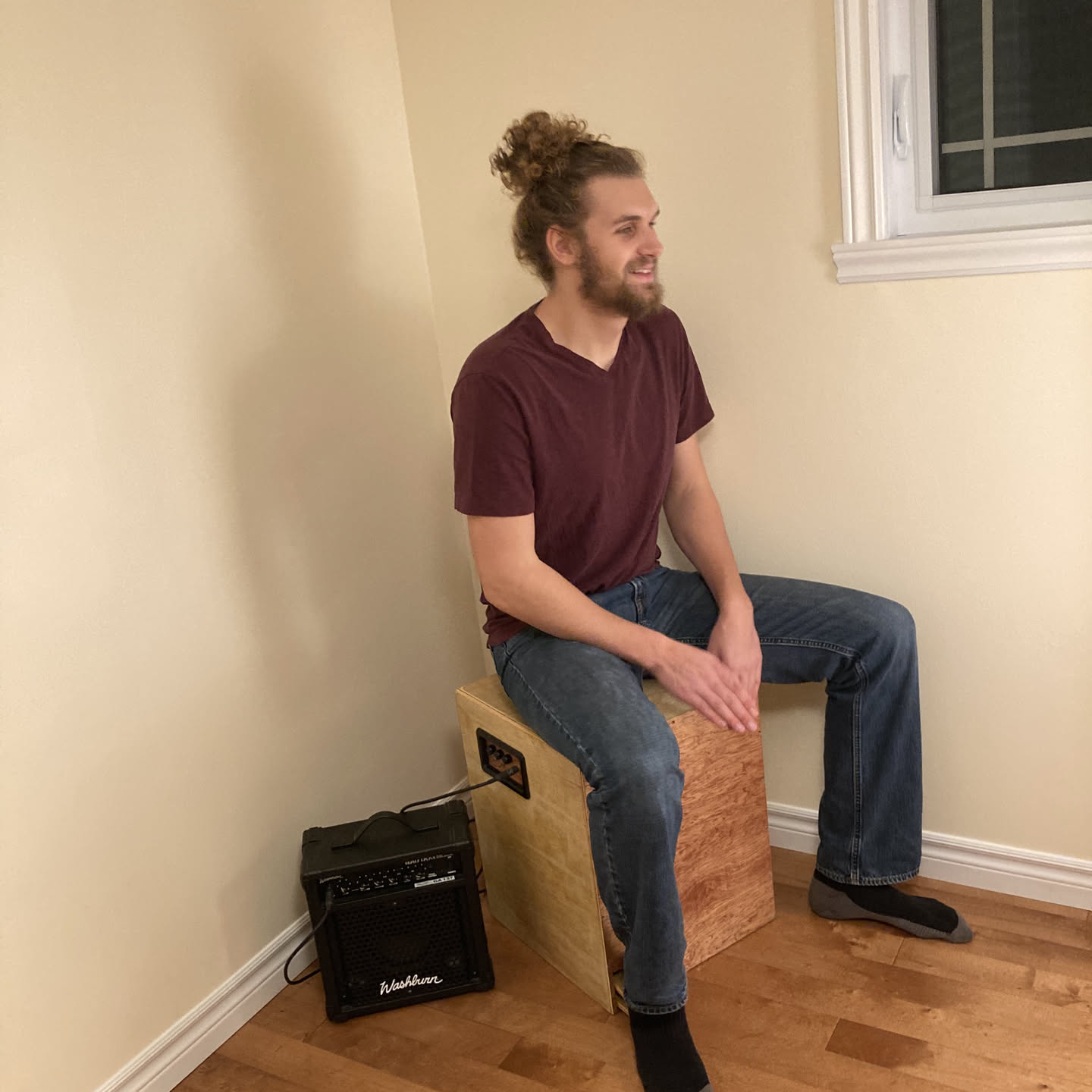
I've always admired the way cajons can bring rhythm to a musical performance in such a small package, at least compared to their larger counterparts, the drum kit. With this, I always thought it would be great if they could be amplified like a guitar, or even be able to pass through pedals for effects and looping. That, and they always seem to be hard on the drummers backs, since they must bend over quite far to reach the bass drum sound at the bottom of the cajon. I set out to create a cajon that addresses these issues.
Challenges & Solutions
Bass drum pedal
This cajon was designed with the snare sound near the top of the face and tom sound near the middle of the face. The bass drum was played using a pedal that came out the front face near the player's right foot. This pedal is connected to a mallet that plays on a panel near the back face of the cajon. This allows the player to stay mostly upright while playing, alleviating back strain.
Amplification
The cajon was designed to have 3 main sounds; snare, tom and bass drum, so I decided to add 3 pickups, one for each sound. These were then passed through a passive volume and tone circuit for the user to control the relative sound volume and filtering. Since the cajon's circuitry was passive, the bass frequency response was limited, so an external amp with bass boost was used to get the booming bass drum sound.
Technical Details
Constructed using red oak plywood, birch plywood, screws and 3D printed components. The screws fasten the red oak faces to the main body as these can be adjusted to tune the sound of the front face. Like a traditional cajon, snare drum snares are used near the top of the front face to give that sound the noise of a snare drum.
The control panel that hosts the volume and tone control, as well as the 1/4-inch jack, was CNC routed on a 3D printer I had retrofitted my dremel on (lol). I then used a laser engraver to engrave the labels for each control.